


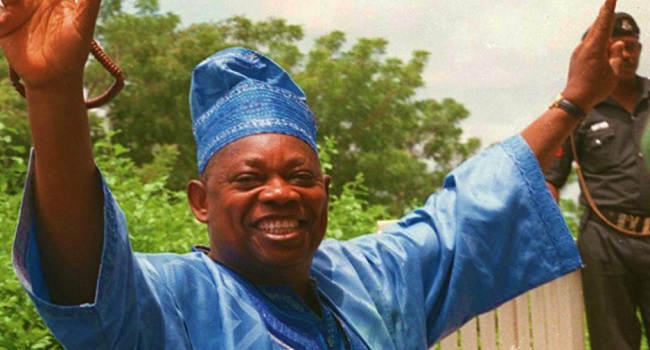
Chief Moshood Kashimawo Olawale Abiola MKO Abiola biography gives details about his life including the June 12 election in Nigeria in 1993, his net worth, family and wives, his automobiles, children, who he is, his death and cause.
Chief Moshood Kashimawo Olawale Abiola GCFR (24 August 1937 – 8 July 1998), usually known as M. K. O. Abiola, was born in Abeokuta, Southern Region, British Nigeria (now Ogun State, Nigeria).
His parents are Salawu and Suliat Wuraola Abiola. His father was a trader in cocoa and his mother in kola nuts.
He was his father’s 23rd kid, but the first to survive infancy. His father named him “Kashimawo” meaning “Let us wait and see.
Early Life and Education
Abiola attended the African Central School in Abeokuta for his primary schooling.
As a kid he helped his father in the cocoa business.
The cocoa company collapsed at the end of 1946 when a shipment was rejected and destroyed by purchasers for low quality.
When Abiola was nine years old, he established his first business selling firewood that he gathered from the forest before school to help his family.
At 15, he created a band and performed at food ceremonies, and he eventually earned enough money to feed his family and finish his studies at Baptist Boys High School in Abeokuta.
He was editor of the school magazine, The Trumpeter, in secondary school, with Olusegun Obasanjo as his deputy editor.
At 19 years of age he joined the National Council of Nigeria and the Cameroons (NCNC) which had more pan-Nigerian beginnings than the Action Group.
Early Business Career
Moshood Abiola joined Barclays Bank in Ibadan in 1956 as a bank clerk.
Two years later he transferred to the Western Region Finance Corporation as an executive accounting officer.
In 1960 he was awarded a government grant to study at the University of Glasgow, where he graduated with a degree in accountancy and became a chartered accountant.
Later, he earned a Fellow of the Institute of Chartered Accountants of Nigeria (ICAN).
Corporate Rise (ITT and Concord Group)
He returned to Nigeria where he worked as a senior accountant at the University of Lagos Teaching Hospital, then at Pfizer, before joining ITT Corporation, where he finally became vice-president for Africa and the Middle East.
While at ITT, he paid off military debts to the company and leveraged it into a bigger role in the company, and on the side created Radio Communication (RCN). He educated staff to sell telecommunications equipment to the military, expanding the business’s commercial reach. So ITT’s Nigerian arm awarded him 49 per cent stock ownership.
Abiola had invested substantially all throughout Nigeria and West Africa. He established Abiola Farms, Abiola Bookshops, Radio Communications Nigeria, Wonder Bakeries, Concord Press, Concord Airlines, Summit Oil International Ltd, Africa Ocean Lines, Habib Bank, Decca W.A. Ltd and Abiola football club.
He also served as chairman of the G15 business council, president of the Nigerian Stock Exchange, patron of the Kwame Nkrumah Foundation and W.E.B. Du Bois Foundation, trustee of the Martin Luther King Foundation, and director of the International Press Institute.
In 1983, he teamed up with Shehu Musa Yar’Adua, Bamanga Tukur and Raymond Dokpesi to establish Africa Ocean Lines which started operations in 1984 and extended its shipping lines to the UK and Northern Europe.
Political Career
At the age of 19, Moshood Abiola went into politics by joining the NCNC. In 1980 he joined the National Party of Nigeria (NPN) and became state chairman, a position he continued to hold after his re-election in 1983. He had presidential ambitions but a 1983 military coup destroyed civilian governance and dashed his political ambitions.
In the 1980s he utilized his journal the National Concord to promote Islamic causes. He campaigned for the Sharia Court of Appeal in the South Western Nigeria and supported the membership of Nigeria in the Organisation of Islamic Cooperation.
In 1984 he was honored with the title of Baba Adinni of Yorubaland by the Islamic elders. Later he set up a Qur’an training institution in Abeokuta, named after his mother Zulihat Abiola.
Ten years of military control had put pressure on General Ibrahim Babangida to hand back Nigeria to democratic rule. Abiola also contested for the social democratic party (SDP) presidential candidacy, beating Baba Gana Kingibe and Atiku Abubakar to win the party’s nomination for the 12 June 1993 presidential election.
Abiola announced his candidacy in February 1993 and won the SDP primaries in March 1993 after a close struggle.
June 12 1993 Election
In the presidential election of 12 June 1993, Kingibe, who had been a rival of Abiola, was his running mate. He beat Bashir Tofa of the National Republican Convention (NRC). The election has been labeled by both national and foreign observers as Nigeria’s most free and fair presidential poll.
Abiola triumphed in a number of states, including Kano, and gained a national mandate, unheard of for a Southern Muslim candidate. Ibrahim Babangida cancelled the poll, causing turmoil across the country. The move destabilised the nation. Later, Sani Abacha grabbed power.
1993 Election: Unofficial Results
The 1993 Nigerian presidential election was between two main candidates:
- M. K. O. Abiola (SDP)
- Bashir Tofa (NRC)
Official results from each state indicated that Abiola won the majority of the states, notably in the South, although Tofa performed better in certain Northern states.
Results from the South
Abiola achieved very large victories in many Southern states:
- Ogun State: Abiola scored 425,725, while Tofa got 59,246.
- Ondo State: Abiola won with 883,024, Tofa 162,994.
- Lagos State: Abiola received 883,965, compared with Tofa’s 149,432.
- Oyo State: Abiola gained 536,011, Tofa 105,788.
- Osun State: Abiola secured 365,266, while Tofa had 72,068.
These results show Abiola’s strong support base in the Southwest and South.
Mixed Results in the South-East
In the South-East, the race was closer:
- Anambra: Abiola 212,024, Tofa 159,258.
- Imo: Tofa won with 195,836, while Abiola had 159,350.
- Enugu: Tofa narrowly led with 284,050, Abiola 263,101.
Northern States: Tofa’s Strongholds
Tofa won several Northern states, often by large margins:
- Bauchi: Tofa 524,836, Abiola 339,339.
- Katsina: Tofa 271,077, Abiola 171,162.
- Kebbi: Tofa 144,808, Abiola 70,219.
- Sokoto: Tofa 372,250, Abiola 97,726.
However, Moshood Abiola still won some Northern states, such as:
- Kano: Abiola 169,619, Tofa 154,809
- Borno: Abiola 153,496, Tofa 128,684
- Taraba: Abiola 101,887, Tofa 64,001
- Yobe: Abiola 111,887, Tofa 64,061
Total Votes and National Impact
After counting the votes, the unofficial totals stood as follows:
- Abiola (SDP): 8,341,309
- Tofa (NRC): 5,952,087
MKO Abiola had a clear national lead, so many observers viewed him as the election winner.
Arrest and Detention
In June 1994 Abiola declared himself the legitimate president of Nigeria in Lagos. General Sani Abacha promptly declared him wanted and sent the police to apprehend him. Abiola was then kept by security personnel for four years, primarily in solitary confinement.
His wife Kudirat Abiola was also killed by gunmen in 1996, after she openly declared her support for him during this period. The authorities promised Abiola his freedom provided he renounced his presidential victory but he rejected the proposal. Later he was outraged when Kofi Annan and Emeka Anyaoku mistakenly said he’d agreed to give up his mandate.
The death and controversy of MKO Abiola.
Moshood Abiola died in Abuja, Nigeria on 7 July 1998 aged 60 years. He died soon after the death of Sani Abacha and on the day authorities were to set him free after four years in captivity.
He abruptly fainted at a meeting with foreign ambassadors, including US officials Thomas Pickering and Susan Rice. The medical teams couldn’t revive him.
After his death, doctors from Nigeria, Canada, the United Kingdom and the United States examined his body independently. They discovered that Abiola had major heart problems for a long time. They also found that the conditions were harsh enough to result in abrupt cardiac failure.
The studies concluded that Abiola died of natural causes of heart illness. This is the official narrative of his death, and is accepted by medical specialists and historical sources.
And yet, many individuals were not pleased with this answer. And that was Abiola, who died in the hands of a military regime that many Nigerians did not trust. He did not receive sufficient medical attention while detained, perhaps worsening his illness, human rights activists say. The government kept many information secret, and people suspected officials were not telling the whole truth. A later Nigerian investigation suggested the then administration undoubtedly knew more about his death than it had admitted.
People have narrated the narrative in many ways over the years. A former security official alleged that others beat Abiola to death but did not offer any proof to substantiate his allegations. Poisoning is also suspected by some yet there is no good evidence to this effect. Investigators have presented no tests or papers to suggest that anyone killed MKO Abiola intentionally.
MKO Abiola Wives and Children
Moshood Abiola had many spouses and about 40 children. Estimates range from around 40 to about 54 confirmed children based on the sources available.
Wives
Moshood Abiola practiced polygamy in accordance with religious and cultural customs,
His known spouses were his first wife, Simbiat Atinuke Shoaga, and Kudirat Abiola, whom he married in 1973 and who later became a key player in Nigeria’s democratic movement before she was assassinated in 1996.
Other wives were Adebisi Olawunmi Oshin, Doyinsola “Doyin” Abiola Aboaba, Modupe Onitiri-Abiola and Remi Abiola, an actress and a mother of two of his children.
Children
He had a large family. Most accounts place the number of his children at over forty, while some reports identify as many as 54.
Hafsat Abiola is among his most prominent children, known for her work in democracy and gender rights.
Other children often referenced in public records include Jamiu Biodun, Abdul Mumuni, Khafila, Moriam, Hadi, Olalekan Yusau, Kola, Lola Abiola-Edewor, Deji, and Hofsad.
Moshood Abiola Family Legacy
His death led to the state of Lagos declaring June 12 a public holiday, a move that other states have emulated. Nigeria formally declared 12 June Democracy Day, replacing 29 May, in 2019. MKO Abiola Stadium and Moshood Abiola Polytechnic were named after him and a statue was built to immortalize his memory.
Musician Fela Kuti attacked him in a song accusing global corporations of plundering Africa’s resources and referenced Abiola. Former president Goodluck Jonathan announced intentions to rename the University of Lagos after Moshood Abiola in 2012, but the administration revoked the decision amid public criticism.
Awards and Recognition
Moshood Abiola was the recipient of many accolades and was globally admired for his work. He twice received the International Businessman of the Year award and was granted honorary doctorates by many universities.
International Honours and Titles
In 1987 he received a particular accolade when Washington, D.C. presented him with a golden key to the city. He also won NAACP awards, a King Centre honor and one from a Paris nonprofit that encourages education.
Traditional Titles and National Honours
Moshood Abiola was the rare and significant Aare Ona Kakanfo of Yorubaland. He was posthumously awarded the Commander of the Federal Republic (CFR) in 1998 and the Grand Commander of the Federal Republic (GCFR) in 2018.
Posthumous Awards
President Muhammadu Buhari moved Nigeria’s Democracy Day from May 29 to June 12 on 6 June 2018 to commemorate the annulled 1993 election and Abiola. Buhari also posthumously conferred on Abiola the highest national accolade, Grand Commander of the Order of the Federal Republic (GCFR). On 11 June, 2019, Buhari signed a bill into law establishing 12 June as a public holiday for Democracy Day.
In February 2025, Babangida admitted he regretted annulling the 1993 election and stated that Abiola had won.
MKO Abiola Net Worth
Moshood Abiola was one of Africa’s richest men, with a net worth of over $1 billion at his peak. He was one of Africa’s richest men, but because his holdings are primarily private, there is no official or agreed-upon number.
M. K. O. Abiola started his commercial career as a small scale trader before developing a wide range of business interests across Nigeria and West Africa.
He rose to prominence through his corporate role at ITT Nigeria, later expanding into media with the Concord Group of newspapers, telecommunications with Radio Communications Nigeria, agriculture and manufacturing with Abiola Farms and Wonder Bakeries, and transportation with Concord Airlines and Africa Ocean Lines.
He also put money into oil and energy with Summit Oil International, banking and finance and real estate, making him one of the most powerful economic titans of his era.


Discussion