


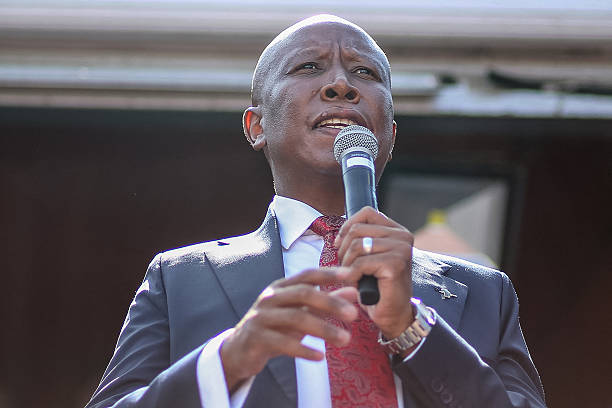
Julius Sello Malema was born on March 3, 1981, in the township of Seshego, near Polokwane, Transvaal, which is currently part of Limpopo. He hails from a Northern Sotho family, and his mother was a domestic servant and a single parent. He was brought up by his grandmother after his mother passed away; she died in May 2019.
Malema finished his schooling at Mohlakaneng High School in Seshego. He obtained a two-year diploma in youth development from the University of South Africa (UNISA) in 2010. He earned a Bachelor of Arts in communications and African languages from UNISA in March 2016 and an Honours degree in philosophy in 2017. He started his master’s program at the University of the Witwatersrand in 2018.
Career
In 2008, Malema held the position of provincial secretary for the ANC Youth League in Limpopo and was a notable candidate for the head of the national league. Outgoing league president Fikile Mbalula backed his candidacy, while outgoing league secretary-general Sihle Zikalala supported the more moderate Saki Mofokeng.
Malema was elected as president of the ANC Youth League during the league’s 23rd National Conference in Bloemfontein in April 2008, after a heated campaign and a chaotic plenary session.
He secured 1,833 votes against Mofokeng’s 1,696 and was elected alongside a group of friends, including Andile Lungisa as deputy president..
The outcome of the vote was quickly contested, especially by conference delegates who claimed that intimidation had stopped them from voting. The conference fell into chaos, with some attendees throwing chairs, and it ended without finishing its agenda.
Later, Malema condemned the “unbecoming conduct” of the conference delegates. After the mainstream ANC stepped in, the league held a special closed congress in Johannesburg in June.
Mofokeng agreed to confirm the results of the April election at the suggestion of ANC secretary general Gwede Mantashe.
Before the 2009 general election, Malema was nominated to run as a Member of Parliament but turned it down, stating that Parliament was “for old people.” Despite this, he was active in campaigning for the ANC and Zuma, who was the party’s presidential candidate, throughout the election.
In April 2009, he and the rest of a league delegation were asked to leave Dora Nginza Hospital in Port Elizabeth, where they had been campaigning for support in the wards.
After the election, Malema started a campaign to visit schools, seemingly to connect with the youth of the nation. Kgalema Motlanthe, who was the ANC deputy president and South Africa’s Deputy President at the time, criticized the visits, stating they disrupted the students’ schooling.
Despite being Zuma’s ally after his victory as President of South Africa in May 2009, Malema and Zuma had a public falling out by mid-2010. Malema later stated that he opposed Zuma after realizing that Zuma was unable to implement the left-wing policy program that had led to his election as ANC president in 2007.
Malema believes that Zuma only adopted a tougher stance toward the league after it rejected him. Another interpretation suggests that in 2010, Zuma shifted his stance toward Malema and the league – especially by starting disciplinary proceedings against Malema – because he recognized that Malema’s outspoken militancy was a political liability or threat to him.
With the end of Malema’s first term as president, many anticipated that he would face a serious challenge for re-election, probably from his deputy Andile Lungisa.
In his home province of Limpopo, the convention involving Malema erupted in violence, with reports suggesting he commanded police to remove his rivals and the media from the venue.
Despite everything, Malema was re-elected as the president of the Youth League at its national elective meeting in Midrand on June 17, 2011. He ran unopposed because his presumed opponent, Lebogang Maile, declined to contest against him. Ronald Lamola took over from Lungisa as the league’s deputy president.
After being expelled from the ANC, Malema became a prominent critic of the government’s actions during the August 2012 Marikana massacre.
In June 2013, Malema started campaigning for his political party, the Economic Freedom Fighters. During a meeting with the SA National Editors’ Forum, South African President Jacob Zuma suggested that the ruling party does not view this development as a threat.
Even while facing charges for money laundering and racketeering, Malema started seeking funds for his new political organization.
In the 2014 general election, the EFF secured 25 seats in the National Assembly, South Africa’s lower house of parliament, just months after it was formed. Initially, Malema threatened to challenge the election results in court, but he ultimately accepted them; however, he maintained his claim in 2016 that the ANC stole the Gauteng election.
He took the oath of office as a National Assembly member on May 21, 2014. He was reelected in the 2019 general election and has served on numerous portfolio committees.
Dispute and Detention
In January 2009, during a student assembly at the Cape Peninsula University of Technology, Malema stated that Khwezi, the woman who accused Jacob Zuma of rape in 2005 (and was acquitted), “had a nice time” with Zuma because she stayed until the morning to ask for “breakfast and taxi money”.
A non-profit organization called Sonke Gender Justice filed a complaint in South Africa’s Equality Court, leading to Malema’s conviction for hate speech on March 15, 2010. He was mandated to issue an unqualified apology and pay a fine of R50,000 to a center for battered women.
The Equality Court found Malema guilty of hate speech on August 27, 2025, for comments he made in 2022. The court ruled that Malema’s statements, which included calls for the murder of a white man, were “a clear attempt to promote hatred.”
On October 1, 2025, the East London Magistrates’ Court convicted Malema of several offenses related to a 2018 incident where he discharged a pistol during a rally at Sisa Dukashe Stadium in Mdantsane, Eastern Cape.
He was convicted under the Firearms Control Act for unlawful possession of a firearm and ammunition, discharging a firearm in a crowded or public place, and reckless endangerment. He received a five-year prison sentence on April 16, 2026. He was allowed to appeal and is free until the results of the following judicial actions.
Julius Malema Wife
In 2014, Malema tied the knot with his long-term fiancée in a private, high-security ceremony in his hometown of Seshego. Their first son, Munzhedzi, was born in 2016. Kopano, their second son, arrived in 2018. Malema has a son, Ratanang, from his previous relationship with Maropeng Ramohlale.
Net Worth
By 2025, Julius Malema’s net worth is expected to exceed R45 million (around $2.5 million USD).
Social Media
X: @Julius_S_Malema



Discussion